
Mapping Marriage: Chemistry, Connection, and Mystery
The personal lives of individuals, and the desire for relationship, are among the most powerful forces in our lives.
I began wondering, in thinking about relationship, how stability and vitality can both be brought into it, and what combines to make that happen. And beyond that, the possibility that real transformation (mystery!!) enters into our lives through relationship.
Intimate relationships are the pinnacle of creation, in that they mirror the way in which the Divine image split into a masculine and feminine component. By recombining, we emulate the union of Heaven & Earth. Although this archetypal or spiritual reality is vast, the practical conditions for a marriage to feel vital, complete, and sustained are difficult to articulate—hence the number of books on the matter.
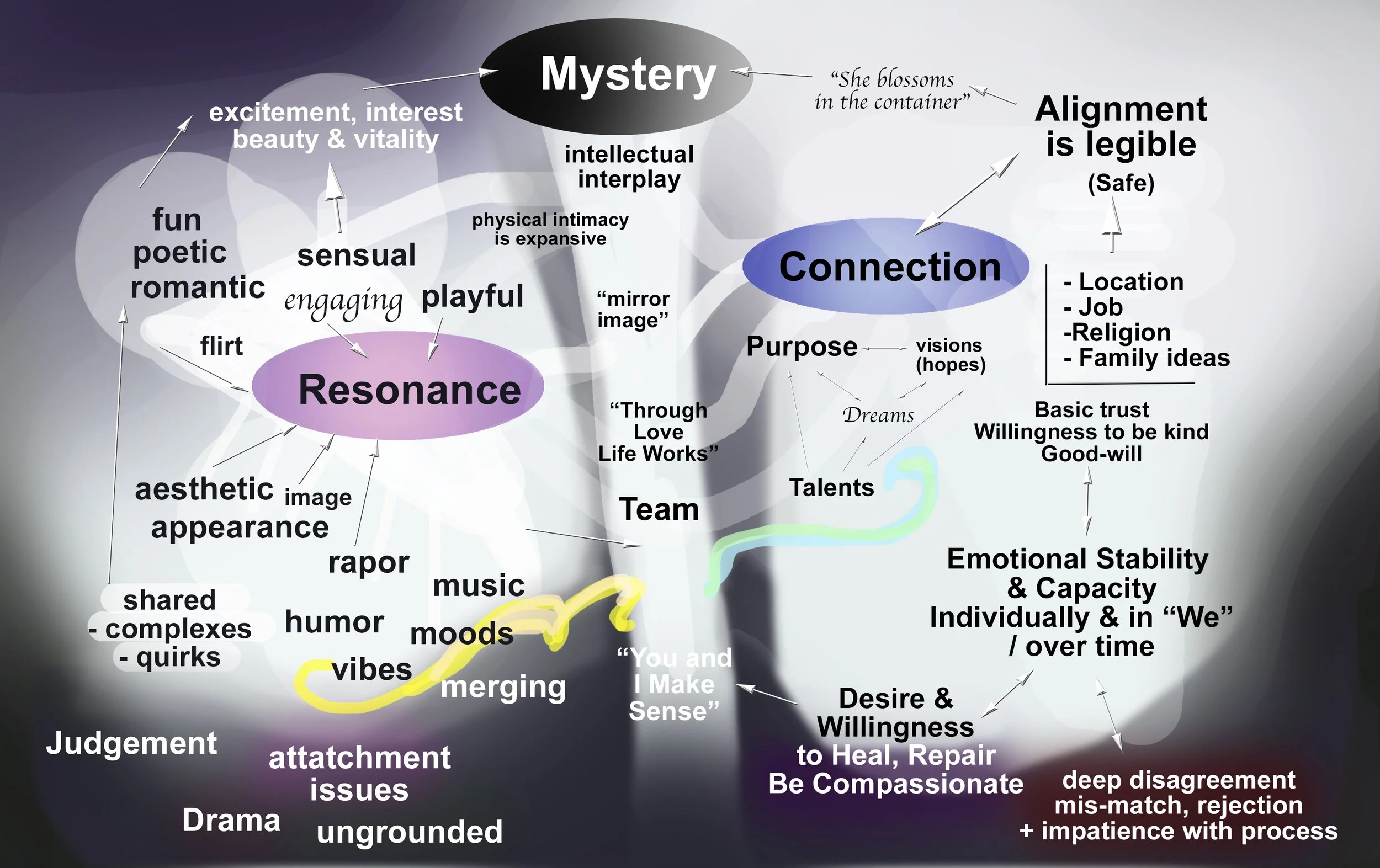
In the school of C.G. Jung, authors like Edward Edinger and Erich Neumann often produced maps. This technique can help differentiate and describe various qualities, values, attitudes, and needs, which can then be integrated. I chose to make such a map about relationship.
Three Pillars
There are three main categories in this map: Resonance, Connection, and a transcendent or mysterious category that I call “Mystery.”
Resonance
Colloquially, we often speak of “chemistry” with another person—a friend, colleague, or intimate partner. I like the term resonance for this experience. It is irrational, subjective, and highly potent. It can be immediate, and it can also develop through familiarity and time.
It is related to the image of the person (their look), the moods we share, the sense of humor, the shared taste. It is found in the ability to speak playfully, to have embodied spontaneity, to feel a kind of vitality in the presence of another.
There is something poetic here, something alive, which cannot be reduced to agreement or structure. It is simply felt.
But alongside this is another domain, which is of a different order entirely. This is what might be called connection.
Connection
Connection defines where we can develop trust through perceived structural security. These are commitments, values, and obligations that bring about a sense of predicate, safety, and—using the popular word today—“alignment.”
These are the identity-informed questions: where we live, how we work, what we believe about family, religion, and purpose. Identity may be malleable, but we do not feel safe if it is fragmented too quickly or too broadly. So match and mismatch can be determined by these conscious commitments. When two people diverge on these matters, the relationship may become difficult to sustain.
And yet, even here, there is nuance. We are not robots; we are always in process, and that process has an autonomous quality if individuation is a factor. So many of these differences are, in principle, subject to change over time. With patience, with goodwill, and with a genuine desire to remain open, we can often stretch toward one another.
But this requires something more than compatibility. It requires a willingness to repair—to return after conflict, to remain compassionate, to hold the relationship together even when it is under strain. Underneath the identity-informed roles and commitments, there is a deeper solidity to connection, defined by the willingness to repair and sustain goodwill toward another person, respecting their autonomy and humanity with patience.
“Fruition Couple,” watercolor variation on a Samuel Abelow theme.
In this sense, connection is not only alignment. It is the creation of safety and structure over time. This safety is largely emotional, while identity factors—since we are all attached to our identities and preferences—help regulate how far we can stretch beyond our emotional limits in relational dynamics.
And then, between these two domains, there is something else.
Mystery
There is what might be called mystery.
Mystery is the factor of what emerges out of connection and resonance. It is also what may compel a couple to engage, continue, and sustain. It is both a result of coherence and a possible impetus toward coming together.
It is the vitality that is born out of the continued engagement between a dyad, which brings meaning and aliveness that otherwise would not have been there. It is not present in all relationships to the same degree, at least consciously, but it is a factor nonetheless. It is often left out of discussions on relationships, even by experts—coaches and psychologists who specialize in the subject.
This factor is expressed in old adages: that through love, something unfolds which cannot be entirely planned, and which is greater than the sum of its parts. It may be at the heart of the deep longing—and pain—that we feel around relationship, despite its challenges.
Conclusion
What becomes evident is that chemistry and connection are not opposing forces, but interdependent ones.
Chemistry without connection leads to intensity that cannot hold.
Connection without chemistry leads to structure without vitality.
But when both are present, and sustained, they can give rise to something else entirely.
A relationship begins to emerge as a form of its own.
Not simply two people in alignment, but something that has become shared—a “we.”
This, perhaps, is what we are ultimately looking for: not only resonance, not only structure, but the possibility that, through both, something real comes into being.