
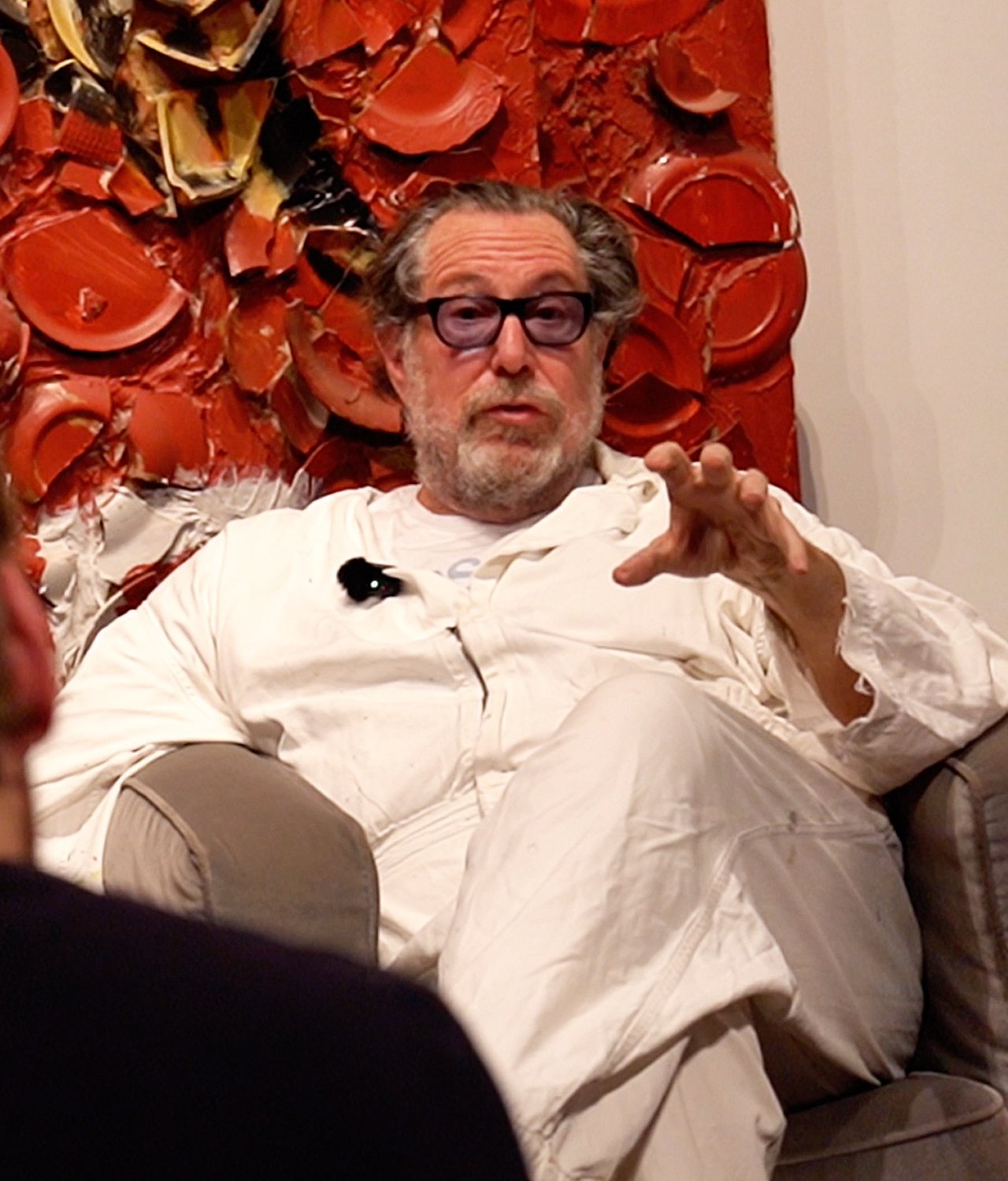
Still frame from documentary mini-episode. Courtesy of Current Arts Foundation.
It was the last question of the night. January. New York. Freezing outside. I asked Julian Schnabel something he’s almost never asked — not about collectors or exhibitions or stories from the past, but about what painting has actually done for him, psychologically, emotionally, spiritually. What followed was intense, personal, and confrontational.
We got it on video.
At the start of the mini-episode, I outline an analysis of Schnabel’s aesthetic: a rejection of minimalism, in favor of the grand and the decadent. And I think that comes out in this lovely quote where he says, like, what do you want me to say — that I would jump off the balcony of my palazzo?
That pink mansion he has — Palazzo Chupi — and just everything that he has and has accomplished, it is decadent, successful, grandiose, and absolutely amazing.
Schnabel is the world’s best worst painter. He is clumsy, awkward with figuration, and yet totally confident. And it’s marvelous how he kept going. It’s a marvel that the oeuvre stands the way it does to this day.
I’m doing a documentary, thanks to Current Arts, which means that I get to film things related to Jewish identity.
Julian Schnabel is a Jewish American artist — born in Brooklyn in 1951, raised in Texas, and one of the defining figures of the 1980s Neo-Expressionist movement. And yet he represents the old guard of assimilation — authority through accomplishment — in the East Coast American story of the post-1950s, baby-boom generation.
Interacting with Schnabel has always taken me to a place of feeling — the sense that I’m in the presence of a blazing sun.
That’s why I call him “Rabbi Schnabel.”
It says in Pirkei Avot:
“Be careful with their coals, lest you be burned… their sting is the sting of a scorpion… and all their words are like fiery coals.” (Avot 2:10)
Great Torah scholars have that quality — like, you better be sharp if you’re going to open your mouth.
But he is no Torah scholar. He’s an artist.
I really wanted to know something that Schnabel is never asked.
And you can see Dana Schutz’s reaction to my question — she’s smiling, almost giddy, surprised, curious what’s going to happen. Because Schnabel never answers questions like this.
He usually talks about things like: when I painted Andy Warhol’s portrait, or who collected the work. Names. Places. Stories.
But something philosophical, emotional, deeply personal — that’s rare.
And when he says:
“Painting saved my life.”
He’s saying something existential.
For him, it’s necessary. The ritual of creative production is life. Without it, he feels he would not be able to sustain living.
I think that’s very Jewish — the existential need for ritual.
When he confronted me — saying, you don’t get a choice, you’re stuck in this life… you’re going to get sick, you’re going to die — what he was really saying was:
Are you familiar with the fact that the world is existential?
It felt personal. Like he was looking at me, sizing me up.
Okay, young man. The world is a tough place. If you get to do what you love, you’re lucky. It’s that simple.
At the same time, no one can explain the stature of art in this world — or the mystery of it.
And I think that’s what I’m exploring.
This mini-episode doesn’t tie all those threads together. But it explores one facet of the story:
Elite art.
New York City.
And the Jewish soul.