
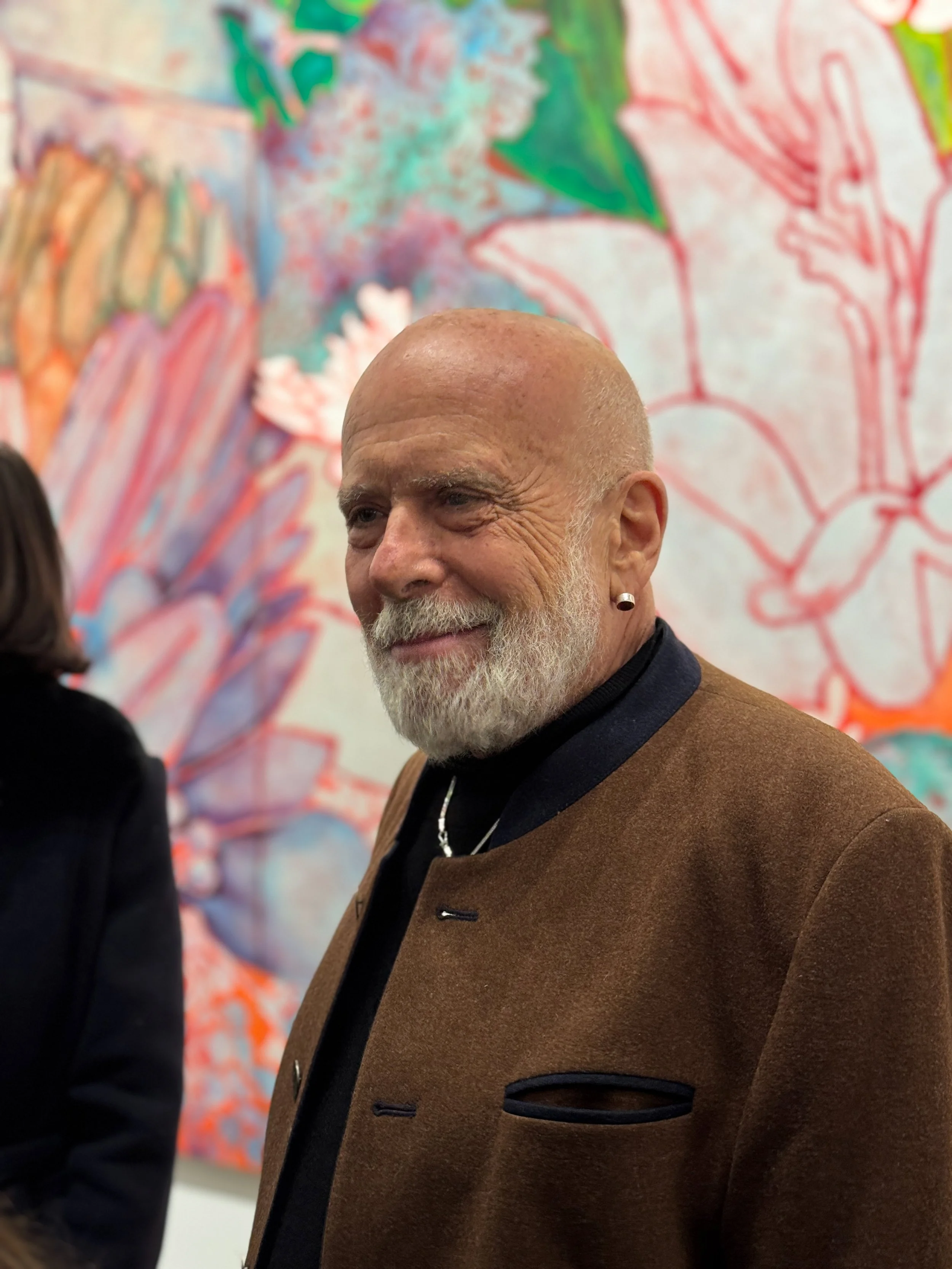
Francesco Clemente photographed at Vito Schnabel Gallery, by Samuel Abelow. On the occasion of the Travel Diary exhibition opening. January 28, 2026.
This exchange took place at the opening of Travel Diary at Vito Schnabel Gallery. I’ve encountered Francesco Clemente before, and he consistently carries the same calm, gracious presence—something of a yogic aura. This time was no different.
At the moment, I’m in the middle of making a documentary that keeps circling a single question: can I genuinely straddle (and synthesize) a fully religious life with a secular, aesthetic art world?
As I explored this with Clemente, I had my voice memo recording. Listening back later, it felt worth editing and publishing the exchange.
An odd man was talking about project to put people on Mars—describing it as the next evolution of humanity.
Francesco Clemente:
“I don’t believe in evolution. We’re in decline.”
Samuel Abelow:
“Our consciousness evolves, though. The soul grows.”
Clemente looked at me as if to say: not really.
Francesco Clemente:
“I think cavemen were more intelligent than we are.”
Samuel Abelow:
“Can I ask you something?”
Francesco Clemente (kindly):
“Yes.”
Samuel Abelow:
“You put a lot of mystical—very personal, mystical—themes into your work. Do you think the art world actually cares about those things? Collectors?”
Francesco Clemente:
“No, they don’t really.”
Samuel Abelow:
“Because centuries ago, art was religious.”
Francesco Clemente:
“The patrons of the arts were responsible people. Today, nobody takes responsibility for anything.”
Samuel Abelow (laughing):
“It’s nihilism.”
Samuel Abelow:
“But your mysticism drives you to paint. That’s the redemptive quality—for you.”
Francesco Clemente:
“And for my viewers. The ones who care. And there are many—because here I am.”
Samuel Abelow:
“So you think there’s a spiritual yearning among them?”
Francesco Clemente (sharply):
“Why do you ask that?”
Samuel Abelow:
“I’m mystically inclined.”
Francesco Clemente:
“Which tradition?”
Samuel Abelow:
“First it was Eastern mysticism. Now my ancestor’s tradition—Jewish, Kabbalah. I live in a Chassidic neighborhood in Crown Heights.”
Francesco Clemente:
“Wow. That’s strong! Amazing.”
Samuel Abelow:
“Yes. Strong. Shabbat. Kosher.”
Samuel Abelow:
“I feel painting can function like a talisman—to focus attention, to change us. I wonder whether that kind of redemption exists for you in painting.”
Francesco Clemente (emphatically):
“I like the word talisman.”
Samuel Abelow:
“I wonder whether the art world cares about that—or whether it’s just the artist’s excuse.”
Francesco Clemente:
“Why do you want to know this? Are you a painter?”
Samuel Abelow:
“Yeah.”
Francesco Clemente (laughing, with charm):
“Oh, it’s not going to help you.”
Samuel Abelow:
“Yeah. I don’t think so either. That’s the conclusion I’ve come to. If it looks good, that will help.”
Francesco Clemente:
“Look—if you’re putting everything you’ve got into it, it’s going to be okay.”
Samuel Abelow:
“Yeah. If the work is good.”
Francesco Clemente:
“Are you putting in the effort?”
Samuel Abelow:
“I believe so. Maybe I’ll show you sometime.”